For many in the UK, a folding powerchair is the key to reclaiming the freedom of the public transport network. However, boarding a bus in Birmingham or a train at London Euston requires more than just a ticket; it requires an understanding of the 2026 “Permit to Travel” schemes and the technical limits of our transport infrastructure.
Whether you’re using the Lightweight Intelligent Powerchair for its portability or the MAS Mobility Auto-Fold for its tight turning circle, here is your roadmap to navigating the UK’s buses and trains with confidence.
1. The “Bus Permit” Scheme: Why Size Matters
In 2026, most major UK bus operators (such as Stagecoach, First, and Arriva) adhere to the CPT Code of Practice. While standard wheelchairs are legally mandated to be allowed on board, “powered mobility devices” are subject to specific size and safety checks.
The “Standard” Requirements: To be eligible for a bus permit, your chair should generally be:
- Width: No more than 600mm.
- Length: No more than 1000mm.
- Turning Radius: Under 1200mm.
The Strategy: Chairs like the Soft-Start Auto-Fold are specifically designed to meet these “London-standard” dimensions. Before you travel, you must apply for a Mobility Aid Recognition Card (or local equivalent). This usually involves a quick assessment at a bus depot where staff confirm your chair can safely navigate the ramp and the internal “wheelchair bay.” Once you have this card, you simply show it to the driver, and they are legally obliged to provide access, provided the space isn’t already occupied.
2. National Rail and the 2026 “Passenger Assist” Update
The UK rail network has seen significant upgrades as of 2026, with the “Accessibility Roadmap” aiming for more step-free stations. However, the rolling stock (the trains themselves) still has physical limits.
- The 300kg Limit: Most train ramps have a safe working load (SWL) of 300kg. This includes the weight of the chair and the user. For users of the KWK D09 Heavy Duty or the HomyKing Heavy Duty, this is rarely an issue, but it is a figure you should know if asked by station staff.
- Booking Assistance: In 2026, you can now book “Passenger Assist” via the National Rail app with just two hours’ notice. This ensures a staff member is waiting with a ramp at both your departure and arrival stations.
- The “Freewheel” Trick: If a train is particularly crowded, owners of the Drive DeVilbiss AirFold often choose to fold the chair and store it in the luggage rack, transferring to a standard seat. This is only possible with ultra-lightweight models and can save you from having to wait for the next train if the designated wheelchair space is full.
3. The Blue Badge “Gateway” Benefits
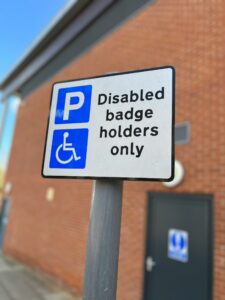
A common misconception is that the Blue Badge is only for car parking. In 2026, the Blue Badge acts as a vital “passport” to other transport savings:
- Disabled Persons Railcard: Your Blue Badge is the primary evidence needed to get a Disabled Persons Railcard. This gives you (and one adult companion) 1/3 off almost all rail fares across the UK.
- Oyster Card Discounts: If you’re in London, you can take your Railcard and your Oyster card to any Underground ticket office. They will “link” them, giving you a 34% discount on off-peak pay-as-you-go fares on the Tube and DLR.
- Community Transport: Many local “Dial-a-Ride” services in the UK prioritize Blue Badge holders for door-to-door transport in accessible minibuses.
4. Navigating the “TfL” Maze (London)
London’s transport system is the most accessible in the UK, but it’s not perfect. In 2026, the Elizabeth Line offers “level boarding” (no ramps needed), but older lines like the Central Line still require staff assistance.
The Pro Tip: Use the “Step-Free” filter on the TfL Go app. It will tell you not just which stations have lifts, but also the gap between the train and the platform. If you are using the MX-MAX All-Terrain, its larger front wheels handle “the gap” much better than smaller, indoor-focused chairs.
5. Summary: Public Transport Checklist
- [ ] Apply for a Bus Permit: Contact your local council or bus operator for a Mobility Aid card.
- [ ] Get the Railcard: Use your PIP letter or Blue Badge to save 33% on every train journey.
- [ ] Check Dimensions: Ensure your chair (like the Voyager 185) fits the 700mm x 1200mm “footprint” required for trains.
- [ ] Download the Apps: “Passenger Assist” and “TfL Go” are essential tools for real-time lift status updates.
The Verdict: For the frequent commuter, the Drive DeVilbiss AirFold is the clear winner for its “luggage-like” portability. However, for those relying on the bus, the Soft-Start Auto-Fold offers the most “compliant” dimensions for a stress-free journey.
Disclosure: This post contains affiliate links. If you make a purchase through these links, we may earn a commission at no additional cost to you.

Frustrated by the lack of honest, plain-English advice, Arthur began independently testing rollators and powerchairs to see which ones lived up to their marketing hype and which ones were left gathering dust in the garage.